
Zero to $1.66M in four months : an Amazon supplement brand launch case study
Cold launch with no reviews, no ranking, no keyword history. Four months later: $1.66M revenue at 41.6% margin.
- 4-Month Sales $1.66M
- 4-Month Profit $782K
- Avg Margin 41.6%
- Avg ROI 417%
- 30-Day Sales $627K+
- 30-Day P&L $279K+
- 30-Day ROI 442.5%
- 30-Day TACOS 14.4%
Performance Snapshot
30 days of steady-state operations after the launch ramp. Sales, P&L, ROI, margin, ACOS, and TACOS across today, yesterday, 7 days, 14 days, and 30 days — the brand holding $627K sales and 44.5% margin in the most recent window.
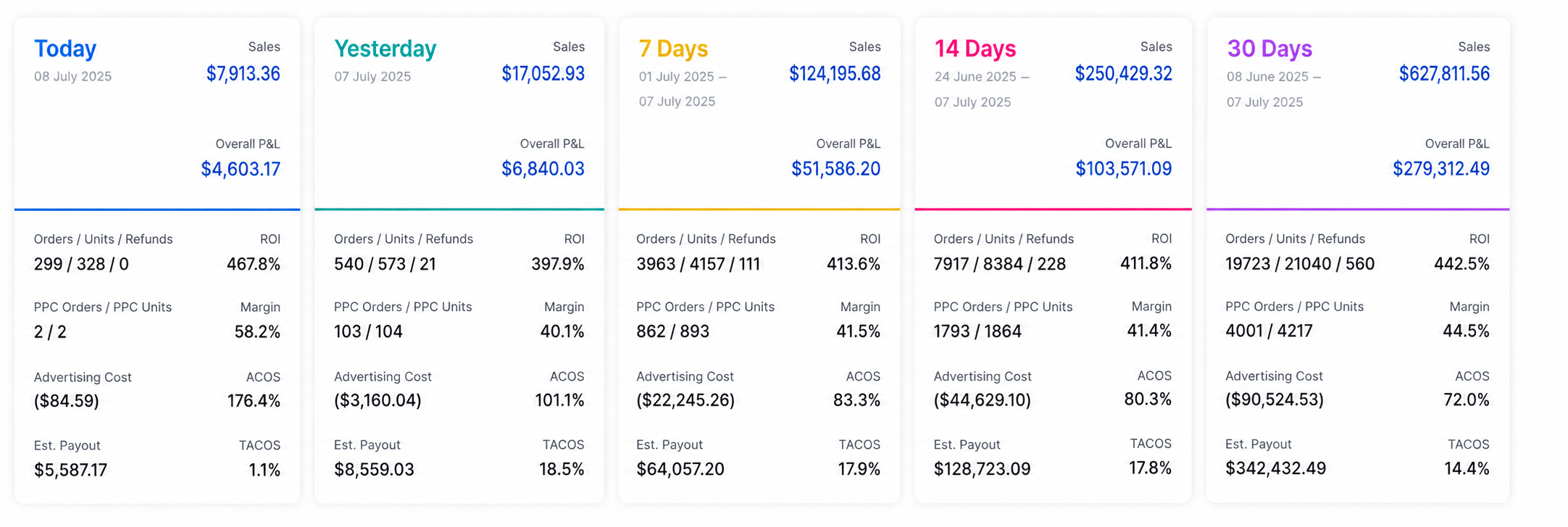
- 30-Day Sales $627.8K
- TACOS 14.4%
- Margin 44.5%
- ROI 442.5%
Brand-identifying information has been removed or anonymized before publishing.
Brand Situation
A new supplement launch needed to be profitable from day one — not eventually.
We launched this supplement brand on Amazon in March 2025 with zero reviews, zero organic ranking, and no keyword history. Supplements are a high-trust category — review count and velocity in the first 60 days decide whether a launch compounds or stalls. The objective was to ramp the product through profitable paid acquisition while seeding review velocity and building the keyword foundation that would compound the spend long after the launch budget cooled.
The Challenge
Launching a supplement is harder than scaling one — every order has to be paid for until reviews and ranking take over.
With no reviews, no ranking, and no keyword history, every dollar of sales in month one has to come from paid acquisition. Supplements add a second layer: buyers don't trust unproven brands, so review velocity in the first 60 days decides whether organic orders can take the load off paid. The challenge was to spend aggressively enough to win both the ranking window and the review window — then transition from launch-cost economics to scale-margin economics inside 90 days.
- 01
Zero Baseline
No keyword history, no organic ranking, no reviews. Every order in the first month had to be paid for. A wrong campaign structure on day one would lock in waste that takes months to unwind.
- 02
Launch-Cost Economics
First-month ACOS of 67% would be a disaster on a mature account; on a launch it's the cost of capturing search real estate. The hard part is knowing exactly when to step bids back down so margin can compound.
- 03
Margin Discipline at Scale
Aggressive launch spend can't compromise the margin profile that scaling depends on. Every campaign had to defend its contribution to net profit — not just sales — even during the ranking window.
What We Fixed
Built from scratch — campaign architecture, keyword strategy, and profitability tracking, all on day one.
-
Campaign Architecture from Launch
Campaigns were built and separated by role before the first ad served: defense, discovery, ranking, and profit-focused. No legacy campaigns to clean up — every campaign earned its keep from week one.
-
Search-Term Discovery + Control
Every search term that produced an order in week one was harvested into exact-match. Every search term that burned spend without converting was negated. The keyword tree was built from real Amazon search data, not from a research tool's guesses.
-
Margin-Aware Bidding
Bids and budgets were set against contribution margin, not topline sales. Even during the aggressive ranking window we never spent past the unit-economics ceiling for the SKU.
Before vs After
From cold launch to $1.66M in four months.
Before Optimization
- Mar 2025 — first month live: $1,019 in sales, 26 orders, no PPC yet, ramp-state negative margin.
- Apr 2025 — PPC turned on at 67.57% ACOS, the cost of buying initial keyword position.
- Zero reviews, zero organic ranking, no keyword history on day one.
- Every dollar of sales for the first 30 days had to be paid for via Sponsored Products.
After Optimization
- Jun 2025 hit 47.02% margin and 11.27% TACOS — peak profitability inside three months from launch.
- 30-day steady state (Jun 8 – Jul 7): $627K sales, $279K P&L, 14.4% TACOS, 44.5% margin.
- Organic orders grew from 845 in Apr to 18,524 in Jun — paid acquisition built the foundation organic compounded on.
- 4-month totals: $1.66M revenue, $782K profit, 417% ROI at 41.6% margin.
Our Strategy
The launch system: build the foundation, win the ranking window, scale into margin.
A profitable Amazon launch in 2025 isn't an ad-buying problem — it's a campaign architecture problem with a tight ranking window. Six moves, in order:
- 01
Launch-Readiness Audit
Before campaigns went live we audited product readiness: listing copy, A+ Content, pricing, inventory cover, review velocity plan, and the competitive set. Launches fail when the listing isn't built to convert paid traffic.
- 02
Campaign Architecture From Zero
The campaign tree was built before launch day — branded defense, exact-match growth, broad-match discovery, product targeting, competitor conquest, and ranking-focused campaigns. Each role had its own ACOS ceiling and budget envelope.
- 03
Keyword Discovery in Week One
The first 30 days were a paid-traffic experiment. Every search term that produced a sale was promoted into exact-match; every wasted impression was negated. The keyword tree was harvested from actual Amazon search data, not seeded from a tool.
- 04
Ranking-Window Bidding
Through weeks two to six we bid above target ACOS on the keywords that needed organic position. Once organic rank held on its own, bids stepped back to margin-target levels. The aggressive spend was time-boxed, not permanent.
- 05
Profitability Tracking From Day One
Margin, ROI, estimated payout, TACOS, refunds, conversion, and PPC-vs-organic share were tracked weekly. The brand never went a week without knowing what its real unit economics were.
- 06
Continuous Optimization
Bids, budgets, search terms, placements, and product-level performance were reviewed weekly. Once the launch arc was complete the same system handled steady-state at $700K+/month.
Scaling Framework
A framework that works for launch and scale because the underlying logic is the same.
Whether a brand is on month one or month forty, the four steps below decide whether ad spend compounds — into ranking, reviews, organic orders, margin — or evaporates.
- Step 01 Identify launch-ready products
Listing conversion, margin headroom, inventory cover, and competitive set were all evaluated before the first dollar of ad spend.
- Step 02 Separate campaign objectives
Defense, discovery, ranking, and profitability each got their own campaigns with their own targets — never blended.
- Step 03 Control search-term quality
Budget was protected by promoting proven terms into exact-match and negating waste in week one — not month three.
- Step 04 Scale with margin visibility
Every scaling decision was measured against ROI, TACOS, margin, and estimated payout — never against topline sales alone.
Measured Results
Four months of launch data: $1.66M revenue, $782K profit, 41.6% margin.
The 30-day window is the steady-state proof. The four-month aggregate is the launch arc that produced it — and it held through every phase, from $1K in Mar to $700K+/month by May.
-
Revenue (4 months)
Sales $1,657,900.71Orders 53,494Units 56,838 -
Profitability (4 months)
Profit $782,779.36ROI 417.07%Margin 41.61% -
Advertising (4 months)
PPC Sales $413,547.71Ad Cost $283,101.32TACOS 16.67%
| Month | Sales | Orders | Margin | TACOS | ACOS | ROI |
|---|---|---|---|---|---|---|
| Mar 2025 (launch) | $1,019.16 | 26 | −10.89% | — | — | — |
| Apr 2025 | $71,420.69 | 2,264 | 15.79% | 42.63% | 67.57% | 158.04% |
| May 2025 | $796,993.22 | 24,847 | 39.31% | 18.94% | 67.91% | 306.65% |
| Jun 2025 | $732,206.41 | 22,361 | 47.02% | 11.27% | 63.46% | 462.77% |
| Jul 2025 (6 days) | $107,142.25 | 3,423 | 41.75% | 17.81% | 80.69% | 416.03% |
Detailed Performance Breakdown
The monthly breakdown of the launch arc. Three months of zero sales (pre-launch), the March 2025 first month, the April PPC ramp, and the May–June scale into steady-state. Decisions were made through full-account analysis — not surface-level PPC metrics — which is why margin climbed from 15.79% in April to 47.02% in June.
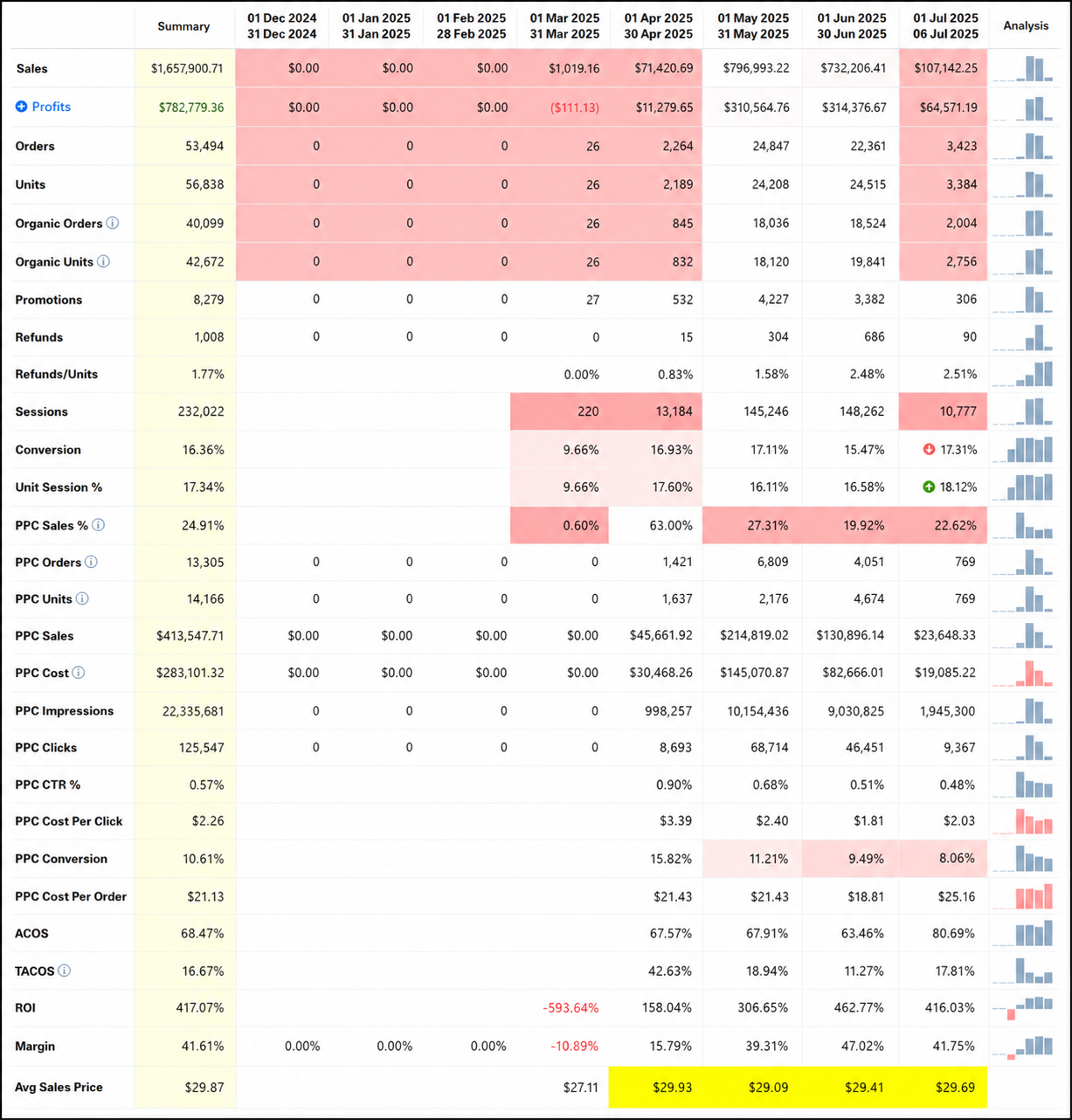
The launch arc visible in the data: organic orders grew from 845 in April to 18,524 in June, while ACOS held steady and margin climbed every month.
Strategic Insights
What this case study proves about Amazon launches.
The data shows a launch system that compounds rather than burns out. Three things the dashboard makes visible:
-
Launches can be margin-positive from month two
April 2025 — the real launch month — hit 15.79% margin even with 42% TACOS. Disciplined launch spend isn't the same as unprofitable launch spend.
-
Steady-state proves the system
If the launch architecture holds, month-four economics (44.5% margin, 14.4% TACOS) should be better than month-two economics. They were. That gap is the proof.
-
Paid scale earns organic scale
Organic orders grew from 845 in April to 18,524 in June. The paid acquisition built the keyword and review foundation that organic orders compounded on for free.
What This Means for Your Brand
If you're launching an Amazon supplement, the question isn't whether to spend on ads.
The question is whether your campaign architecture is built to harvest search data into exact-match, whether your bid logic respects unit economics during the ranking window, and whether you're tracking margin and review velocity from day one — not month six. Supplements are an unforgiving category: a launch that doesn't build review velocity inside the first 60 days rarely recovers. A good launch system is the difference between $1.66M in profit and $1.66M in lost ad spend.
Key Takeaways
Four months of launch data, one consistent pattern.
- Campaign architecture was built before launch day — not retrofitted after the first month of waste.
- Every keyword in exact-match was harvested from real Amazon search data, not seeded from a research tool.
- Ranking-window bid premiums were time-boxed — once organic position held, bids dropped to margin-target levels.
- Margin, ROI, TACOS, and organic share were tracked weekly from week one, not after a quarter of spend.
The brand didn't reach $1.66M in four months because we spent harder. It got there because every dollar of spend was structured to compound — into ranking, into reviews, into organic orders, into margin.
More results
Other brands we've scaled.
- €399€17,3668 monthsTurnaround 8 months
€399 → €17K profit turnaround
Stuck at €399/month and bleeding −€91 in losses. Eight months later: €17,366/month with +31% margin.
€399 → €17,366
Monthly revenue
−€91 → €5,637
Monthly profit
27.9% → 18.4%
ACOS
Read the full case study - €24,436€48,5206 monthsScale 6 months
Doubling a profitable brand
Profitable but plateaued at €24–34K/month with 600–700 orders. After six months: revenue doubled, profit up 51%.
€24,436 → €48,520
Monthly revenue
616 → 1,216
Monthly orders
€7,891 → €11,893
Monthly profit
Read the full case study - €6,248€10,000+6 monthsBreakthrough 6 months
Breaking the €6K plateau
Stuck at €6,000/month with 66% of sales paid. After six months: broke €10K and added +200 orders/month.
€6,248 → €10,000+
Monthly revenue
66% → <50%
PPC share
Plateau → +200/mo
Orders added
Read the full case study - $186K$415K90 daysScaling 90 days
Pet brand: 2.2× in a quarter
A pet-category brand softened to a $186K February trough, then scaled 2.2× in a single quarter — on track for a $415K May (forecast) — on a four-pillar PPC, listings, catalog, and inventory playbook.
$186K → $415K
Monthly sales (May forecast)
5,092 → 12,425
Units / month
20,969 → 36,135
Monthly sessions
Read the full case study
Book your free Profit-Leak Audit.
30 minutes. We'll size every leak in dollars and show you which to plug first.
Book the auditYour data stays yours. See our Privacy Policy and Terms.
Brand-identifying information has been removed or anonymized to protect client confidentiality.